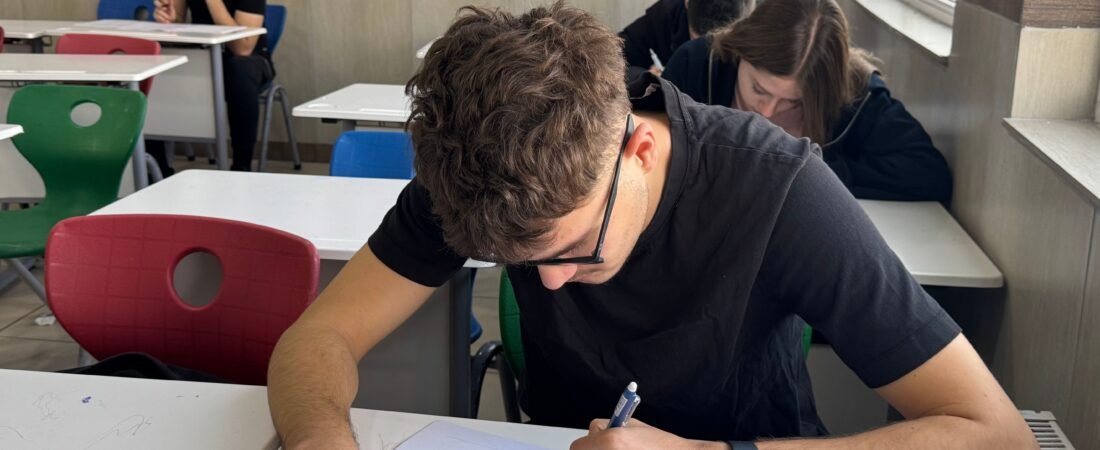
If you are a Class 10 or Class 12 student of the UP Board, your practical exams come before your written papers — and they carry real marks. Many students spend all their energy on theory and treat practicals as a formality. That is a mistake. In Class 10, practicals and internal assessment are worth 30 marks out of 100 in each subject. In Class 12, the revised 2027 pattern gives 20 marks to practicals or internal assessment. Those marks are often the difference between a first division and a second division, or between passing comfortably and struggling.
This guide covers everything you need to know about the UP Board Practical Exam 2027: the dates, how the marks are divided, how practicals and viva actually work in your school, and how to prepare without panic.
UP Board Practical Exam 2027 at a Glance
| Detail | Class 10 (High School) | Class 12 (Intermediate) |
|---|---|---|
| Board | Uttar Pradesh Madhyamik Shiksha Parishad (UPMSP), Prayagraj | Uttar Pradesh Madhyamik Shiksha Parishad (UPMSP), Prayagraj |
| Practical exam window | 27 January – 10 February 2027 | 27 January – 10 February 2027 |
| Theory exams | 5 – 24 February 2027 | 5 – 24 February 2027 |
| Theory marks per subject | 70 | 80 (revised for 2027) |
| Practical / internal assessment marks | 30 | 20 (revised for 2027) |
| Total marks per subject | 100 | 100 |
| Passing marks | 33% in each subject | 33% in each subject |
| Where practicals are held | Your own school | Your own school |
| Official website | upmsp.edu.in | upmsp.edu.in |
The practical window of 27 January to 10 February 2027 comes from the UPMSP academic calendar for 2026–27 and is repeated across the board’s timetable coverage. The theory timetable itself was released by UPMSP on 12 October 2026, with written exams running from 5 to 24 February 2027. For the full written-paper schedule, see the UP Board Exam 2027 Time Table. Your school will give you your exact practical date and batch — the board gives the window, but the day and time for your subject are fixed by your school.
One honest note: a few education portals report the Class 12 practicals in two phases — 21 to 28 January 2027 for one set of divisions and 29 January to 5 February 2027 for the rest. That phase-wise schedule has been reported for earlier years too, and it does not match the 27 January–10 February window in the academic calendar. Until UPMSP publishes a separate practical-exam notice, treat 27 January–10 February 2027 as the working window and confirm your personal date with your school. Do not plan travel or other work on the basis of a portal’s dates alone.
Important Dates Around the Practical Exams
Practical exams do not arrive out of nowhere. A few dates before them matter just as much, because they decide how ready you are.
| Event | Date |
|---|---|
| Syllabus completion target for schools | 10 January 2027 |
| Class 12 pre-board practicals begin | 11 January 2027 onwards |
| Written pre-board exams begin | 18 January 2027 onwards |
| Board practical exam window | 27 January – 10 February 2027 |
| Theory exams begin | 5 February 2027 |
| Theory exams end | 24 February 2027 |
| Admit cards | Expected in January 2027 (check with your school) |
| Result | Expected April–May 2027 |
The pre-board practicals from 11 January are your rehearsal. Take them seriously — they are usually the last chance to find out which experiments you cannot yet do smoothly, and to get your practical file checked and corrected before the real exam.
Class 10 vs Class 12: Marks Distribution Explained
Every UP Board subject carries 100 marks in total. The split between the written paper and the practical or internal assessment is different for the two classes in 2027.
Class 10 (High School): 70 theory + 30 internal/practical. The 70-mark theory paper has two parts — 20 MCQs in Section A, answered on an OMR sheet, and 50 marks of short and long answers in Section B. The remaining 30 marks come from internal assessment or a practical exam, depending on the subject. Science has a practical exam; other subjects use internal assessment such as projects, assignments and periodic tests.
Class 12 (Intermediate): 80 theory + 20 practical/internal. This is a change for 2027. Earlier, Class 12 science subjects followed a 70 theory + 30 practical split, while many non-science subjects were 100 marks of theory only. For 2027, UPMSP has moved all Class 12 subjects to a uniform 80-mark theory paper plus 20 marks of practical or internal assessment. Some syllabus pages still show the older 70+30 split for science subjects, so if your teacher or your school’s syllabus copy says something different, ask your teacher to check the official subject blueprint on upmsp.edu.in or the UP Board Syllabus 2026-27. The 80+20 pattern is the one reported in the 2027 exam-pattern coverage that cites UPMSP.
Why does this matter? Because 20 or 30 marks are not “free” marks, but they are the most predictable marks in your result. Theory papers can surprise you with a difficult question. Practical marks reward steady work you have already done — your file, your experiments, and how confidently you answer a few viva questions. Students who prepare for practicals properly often score nearly full marks in this component, and that lifts the whole subject total.
Subject-Wise Practical Marks: Class 12
The table below shows the theory and practical/internal split for the main Class 12 subjects under the revised 2027 pattern (80 theory + 20 practical or internal assessment for all subjects).
| Class 12 Subject | Theory | Practical / Internal | Total |
|---|---|---|---|
| Physics | 80 | 20 (Practical) | 100 |
| Chemistry | 80 | 20 (Practical) | 100 |
| Biology | 80 | 20 (Practical) | 100 |
| Mathematics | 80 | 20 (Internal Assessment) | 100 |
| Accountancy | 80 | 20 (Internal Assessment) | 100 |
| Business Studies | 80 | 20 (Internal Assessment) | 100 |
| Economics | 80 | 20 (Internal Assessment) | 100 |
| Hindi / General Hindi | 80 | 20 (Internal Assessment) | 100 |
| English | 80 | 20 (Internal Assessment) | 100 |
| History | 80 | 20 (Internal Assessment) | 100 |
| Geography | 80 | 20 (Internal Assessment) | 100 |
| Political Science | 80 | 20 (Internal Assessment) | 100 |
| Sociology | 80 | 20 (Internal Assessment) | 100 |
For science subjects, the 20 practical marks are earned in the laboratory in front of an examiner. For subjects without a laboratory practical — such as Mathematics, Hindi, English and the Commerce and Arts subjects — the 20 marks come from internal assessment: projects, assignments, periodic tests and classroom work done through the year. If you have ignored your project work all year, now is the time to finish it properly, because those marks count exactly the same as practical marks.
Subject-Wise Practical Marks: Class 10
Class 10 keeps the 70 theory + 30 internal/practical split for every subject.
| Class 10 Subject | Theory | Internal / Practical | Total |
|---|---|---|---|
| Hindi | 70 | 30 (Internal Assessment) | 100 |
| English | 70 | 30 (Internal Assessment) | 100 |
| Mathematics | 70 | 30 (Internal Assessment) | 100 |
| Science | 70 | 30 (Practical) | 100 |
| Social Science | 70 | 30 (Internal Assessment) | 100 |
In Class 10, Science is the subject with a real laboratory practical. The other subjects are assessed internally by your school through projects, assignments and tests. That does not mean the marks are automatic — your school sends these internal marks to the board, and a weak project or missed assignments can cost you marks you will never get back.
How the Practical Exam Actually Works
If you have never given a board practical before, the process can feel mysterious. Here is what normally happens, step by step.
1. Your school fixes your date and batch. Practical exams are held in your own school’s laboratory, not at an outside exam centre. Students are divided into batches, and each batch is given a date and time within the board’s window. Your school will put up a notice or tell you in class. Check the notice board yourself — do not depend on a classmate to pass the message on.
2. An external examiner visits your school. UPMSP appoints an external examiner for the practical exams. Your own subject teacher is usually present as the internal examiner, but the external examiner conducts the exam and awards the marks. This is why practicals feel different from a normal school test — you are being watched by someone who does not know you.
3. You perform an experiment. In Physics, Chemistry or Biology, you are given an experiment to perform — usually drawn by lot or assigned from the list of experiments in your syllabus. You set up the apparatus, carry out the experiment, take readings, and write down your observations and result. Common examples include finding the focal length of a lens in Physics, a titration in Chemistry, or preparing a slide and identifying a specimen in Biology. You are judged on whether you can actually do the experiment, not just write about it.
4. Your practical file is checked. You must carry your practical record file — the notebook in which you have written up all the experiments from the year, with diagrams, observations and results, signed by your teacher. The examiner checks that the file is complete, neat and genuine. An incomplete or unsigned file loses marks directly.
5. The viva takes place. After the experiment, the examiner asks you a few oral questions — the viva. These are usually short questions about the experiment you just did, the apparatus you used, the principle behind it, and basic definitions from the chapter. The viva is not a separate theory test; it checks whether you understood what you did with your own hands.
6. Marks are recorded and sent to the board. The examiner awards marks for the experiment, the file and the viva, and your school sends these marks to UPMSP. Together with your theory marks, they make up your final result.
What Is Inside the Practical Marks?
Students often ask for the exact split — how many marks for the experiment, how many for the file, how many for the viva. UPMSP does not publish one fixed sub-split that applies to every subject in the same way, and the exact division is set out in the subject-wise blueprint and the practical exam instructions issued to examiners. As a general guide, the experiment itself carries the largest share, with the practical file and the viva making up the rest — but do not take any particular number from a random website as final. Ask your subject teacher for the split used in your subject this year, and check the official syllabus PDF on upmsp.edu.in if you want to verify it yourself.
What is certain is that all three parts count. A student who performs the experiment well but has no file, or who has a beautiful file but cannot answer a single viva question, will lose marks. Prepare for all three.
Preparation Tips for UP Board Practical Exam 2027
Start with the experiment list, not the textbook. Get the official list of experiments for your subject from your teacher or the syllabus. Write down every experiment and mark the ones you have actually performed in the lab. The ones you have only read about are your danger zone — practise those first.
Practise each experiment at least twice. Reading an experiment is not the same as doing it. The first time you do a titration or set up an optics bench, you will be slow and unsure. The second time, your hands know what to do. If your school lab is open for practice, use it. If not, practise the steps mentally in order — apparatus, procedure, readings, precautions, result — until you can recite them without the book.
Finish your practical file now, not in the last week. A complete, neat file with labelled diagrams and signed pages is the easiest set of marks in the whole exam. Write every experiment in your own handwriting, draw the diagrams yourself, and get each one signed by your teacher as you finish it. A file completed in a rush the night before the exam looks rushed, and examiners notice.
Learn the “why”, not just the “how”. Viva questions are almost always about the experiment you performed: why you used that apparatus, what the principle is, what would happen if you changed one thing. For every experiment, learn one line of principle and one precaution. That alone answers most viva questions.
Revise definitions and formulas of the practical chapters. In Physics, know the formulas you use in the experiment. In Chemistry, know the reactions and the indicators. In Biology, know the names and functions of the specimens and slides. Short, direct answers score better in a viva than long, confused ones.
Prepare your documents the day before. Keep your admit card, school ID and practical file ready the evening before your practical. Reach school early, wear your school uniform, and carry your own pen, pencil, scale and calculator if your subject allows it. Do not borrow apparatus or stationery at the last minute.
Stay calm during the experiment. If a reading goes wrong, do not panic. Note the reading honestly, check your apparatus once, and if needed, repeat the step calmly. Examiners expect school students to make small errors — they mark your method and understanding, not just a perfect final number. Never copy another student’s readings; it is easily spotted and can cost you the whole practical.
Do not skip the pre-board practical. The pre-board practical from 11 January is a full rehearsal with your own teachers. Treat it like the real exam — same file, same preparation, same seriousness. Whatever goes wrong there is a problem you can still fix before 27 January.
Common Mistakes Students Make
- Leaving the practical file incomplete. An unfinished file is the most common and most avoidable loss of marks.
- Memorising experiments without doing them. Students who only read the procedure freeze when they have to handle real apparatus.
- Ignoring internal assessment subjects. In Class 12, subjects like English, Hindi and Economics now carry 20 internal marks. A missing project hurts just as much as a failed experiment.
- Not confirming the date and batch. Every year, some students turn up on the wrong day or miss their batch because they relied on a friend’s message instead of the school notice.
- Over-preparing theory and ignoring practicals until the last week. Practical marks are the most predictable marks available to you. Leaving them to the last week is leaving easy marks on the table.
What to Carry on Practical Exam Day
- Your admit card (once issued) and school identity card
- Your signed practical file or record book
- Pen, pencil, eraser, scale and geometry box
- Calculator, if allowed for your subject
- A calm mind — and the habit of reading the question or instruction slip fully before touching the apparatus
FAQs
1. When are the UP Board Practical Exams 2027?
As per the UPMSP academic calendar for 2026–27, the practical exam window is 27 January to 10 February 2027 for both Class 10 and Class 12. Your school will fix your exact date and batch within this window, so confirm it from your school notice board.
2. How many marks are practicals worth in UP Board 2027?
In Class 10, practicals or internal assessment are worth 30 marks out of 100 per subject. In Class 12, under the revised 2027 pattern, practicals or internal assessment are worth 20 marks, with an 80-mark theory paper. Some older sources still show 70+30 for Class 12 science subjects, so verify the final split from the official blueprint on upmsp.edu.in.
3. Where are the practical exams held?
In your own school’s laboratory. An external examiner appointed by UPMSP conducts the exam, with your subject teacher present as the internal examiner.
4. Do I need my practical file for the exam?
Yes. Your practical record file, with all experiments written up, diagrams drawn and pages signed by your teacher, is checked by the examiner and carries marks. An incomplete or unsigned file loses marks.
5. What is asked in the viva?
Short oral questions, usually about the experiment you just performed — the principle behind it, the apparatus, the precautions, and basic definitions from that chapter. Short, confident, direct answers score well.
6. What are the passing marks for UP Board 2027?
You need a minimum of 33% in each subject. Practical and internal marks are counted in your subject total, so strong practical marks can help you cross the pass line and improve your division.
Final Words
The practical exam is the one part of the board exams where you know the questions in advance — the experiments are all in your syllabus, your file is in your hands, and the viva comes from chapters you have already studied. That makes it the fairest and most rewarding part of the exam. Use the time between now and 27 January well: finish your file, practise every experiment twice, and learn the principle behind each one. Then, when the theory exams begin on 5 February, you will walk in with 20 or 30 marks already working in your favour.
Sources
- UPMSP official website — upmsp.edu.in (timetable, academic calendar 2026–27 and syllabus PDFs)
- UP Board Exam Pattern 2027 (revised 80+20 pattern for Class 12, practical window 27 January–10 February 2027) — https://collegedunia.com/exams/up-board/exam-pattern
- UP Board Date Sheet 2027, UPMSP time table released 12 October 2026; practical exams listed 27 January–10 February 2027 — https://schools.aglasem.com/up-board-time-table/
- UP Board Time Table 2027, academic calendar milestones including pre-board practicals from 11 January 2027 — https://revisiontown.com/up-board-exam-date/
- UP Board Exam Dates 2027, practical exams confirmed 27 January–10 February 2027 — https://collegedunia.com/exams/up-board/exam-dates
- UP Board Class 12th 2027, two-phase practical reporting (Phase 1: 21–28 January, Phase 2: 29 January–5 February 2027) — https://zollege.in/exams/up-board



Leave a Reply