
If you are preparing for the UP Board Class 10 or Class 12 exams in 2027, previous year question papers are one of the most useful things you can practise with. They show you how the board actually asks questions — not how a guidebook guesses it will ask them. The length of the answers expected, the way marks are divided between sections, the topics that come back year after year: all of this is visible in a real past paper in a way no amount of reading notes can show.
But there is also a lot of confusion around these papers. Many websites promise “direct PDF download” links and then send you to old papers from the wrong year, papers from a different board, or pages that ask for your phone number before showing anything. Some students even pay money for what is freely available. This guide clears that up honestly: what the board itself officially provides, where to get it, how to get genuine previous year papers, and how to actually use them in the weeks before the exam.
The theory exams for Class 10 and Class 12 in 2027 will be held from 5 February to 24 February 2027, in two shifts — 8:30 AM to 11:45 AM and 2:00 PM to 5:15 PM. The practical exams are scheduled in the window from 27 January to 10 February 2027. That gives you December and January for serious written practice, which is exactly when previous year papers help the most.
First, Understand the Difference: Model Paper vs Previous Year Paper vs Guess Paper
Students often use these three terms as if they mean the same thing. They do not, and mixing them up is the reason many students practise with the wrong material.
A model paper (also called a sample paper) is issued by the board itself — the Uttar Pradesh Madhyamik Shiksha Parishad (UPMSP), Prayagraj — before the exam. It is the board’s own example of how the coming exam paper will look: the same structure, the same type of questions and the same marking pattern. For the 2026-27 session, UPMSP has released official model papers for around 34 subjects in Class 10 and around 44 subjects in Class 12. These are free PDF downloads from the board’s official website, upmsp.edu.in.
A previous year question paper is the actual paper that students sat in a past exam — for example, the real Class 10 Science paper from the 2026 board exam, or the Class 12 English paper from 2025. These are the most realistic practice material that exists, because they are real exam papers, not samples.
A guess paper is prepared by a coaching institute, a publisher or a website. It predicts which questions might come. Some guess papers are made carefully by experienced teachers, but they are still predictions, not board material. Never treat a guess paper as a replacement for the model paper or a previous year paper.
For your preparation, the order of trust is simple: model papers first (they show the current pattern), then previous year papers (they show the real thing), and guess papers only last, if at all.
What UPMSP Officially Provides — and What It Does Not
Here is the honest position, checked against the board’s own website on 23 November 2026.
What the board officially provides: UPMSP publishes the current session’s model papers on its official website, upmsp.edu.in. Go to the homepage, look for the “Model Paper” link, select your class — High School (Class 10) or Intermediate (Class 12) — and then your subject. The PDF opens and you can download it for free. No login and no payment are needed. The board also publishes the syllabus for Classes 9 to 12 on its Board Syllabus page, which is how you check that a paper matches the current syllabus.
What the board does not provide in one place: UPMSP does not maintain a single official archive page where you can download the actual question papers of past years (2026, 2025, 2024 and so on) subject by subject. That is the fact students need to know before they start searching. Any website that claims to offer “official UPMSP previous year paper direct download links” for past exam years is not linking to an official board archive, because no such archive page exists on upmsp.edu.in. This article therefore gives you no fabricated download links — instead, it tells you the real ways students actually get these papers, below.
That does not mean previous year papers are hard to find. It means you should get them from the right places and check them before you trust them.
How to Get Genuine Previous Year Papers
There are four reliable ways. Use them in this order.
1. Your school and your teachers. This is the best source, and most students ignore it. Schools keep sets of past board papers — many teachers have printed collections going back several years, and some schools distribute them before the pre-board exams. Ask your subject teacher directly for the last three years’ papers in your subject. Teachers can also tell you which questions from old papers are still relevant under the current syllabus and which ones belong to topics that have been removed.
2. The official model papers on upmsp.edu.in. These are not past papers, but for practice purposes they are the closest official material to the real thing, and they follow the current 2026-27 syllabus exactly. Download the model paper for every subject you are appearing in, and treat them as your first set of practice papers. If you solve nothing else, solve these.
3. Senior students and school libraries. Students who appeared in the 2026 or 2025 board exams often still have their question papers, or the solved-paper books they used. A school library usually stocks solved previous year paper books from known publishers. Borrowing one book and photocopying the papers you need costs very little and gives you several years of papers at once.
4. Reputed education portals. Several well-known education websites republish UP Board previous year papers and model papers with subject-wise tables. These can be useful, but check before you download: the paper should carry the correct year, class and subject code on its first page, and the questions should match the current syllabus. Do not pay for a paper, do not enter your phone number or personal details to “unlock” a download, and do not download from a site that shows a paper for one subject but delivers another. If a site’s “2026 paper” looks identical to its “2025 paper”, it is a copied file — leave it and use another source.
A warning that applies to all four routes: always check the PDF header before you practise. It should show the session year (for example 2025-26 for the 2026 exam) and the subject code. Class 10 subject codes start with 9 (901 Hindi, 917 English, 928 Mathematics, 931 Science, 932 Social Science) and Class 12 codes start with 1 (101 Hindi, 117 English, 131 Mathematics, 151 Physics, 152 Chemistry, 153 Biology). If the code on the paper does not match your subject, you have the wrong file.
Subject-Wise Availability: What You Can Expect to Find
The table below is a realistic picture of what is available for the main subjects. “Model paper (official)” means UPMSP has released a 2026-27 model paper for that subject on upmsp.edu.in. “Previous year papers” means actual past exam papers, which you will find through your school, seniors or reputed portals — not from a single official download page.
| Subject | Class 10 | Class 12 | Best source |
|---|---|---|---|
| Hindi | Model paper (official) + past papers | Model paper (official) + past papers | upmsp.edu.in for the model paper; school for past papers |
| English | Model paper (official) + past papers | Model paper (official) + past papers | upmsp.edu.in for the model paper; school for past papers |
| Mathematics | Model paper (official) + past papers | Model paper (official) + past papers | upmsp.edu.in for the model paper; school for past papers |
| Science | Model paper (official) + past papers | — (see Physics, Chemistry, Biology) | upmsp.edu.in for the model paper; school for past papers |
| Social Science | Model paper (official) + past papers | — (see History, Geography, Civics, Economics) | upmsp.edu.in for the model paper; school for past papers |
| Physics | — | Model paper (official) + past papers | upmsp.edu.in for the model paper; school for past papers |
| Chemistry | — | Model paper (official) + past papers | upmsp.edu.in for the model paper; school for past papers |
| Biology | — | Model paper (official) + past papers | upmsp.edu.in for the model paper; school for past papers |
| Accountancy | — | Model paper (official) + past papers | upmsp.edu.in for the model paper; school for past papers |
| Business Studies | — | Model paper (official) + past papers | upmsp.edu.in for the model paper; school for past papers |
| History / Geography / Civics / Economics | — | Model paper (official) + past papers | upmsp.edu.in for the model paper; school for past papers |
| Sanskrit | Model paper (official) + past papers | Model paper (official) + past papers | upmsp.edu.in for the model paper; school for past papers |
| Computer | Model paper (official) + past papers | Model paper (official) + past papers | upmsp.edu.in for the model paper; school for past papers |
For smaller subjects — regional languages, vocational subjects, Drawing, Home Science, NCC — model papers are also released for most of them, but past year papers are harder to find. In that case, the model paper plus your textbook exercises are enough. Do not waste days hunting for a five-year-old paper in a subject where one good model paper covers the pattern.
The Exam Pattern the Papers Will Show You
Solving a previous year paper is only useful if you know what pattern to look for. The pattern below is confirmed by the official model papers for 2026-27 and by the UP Board syllabus.
Class 10: Each subject is worth 100 marks in total — 70 marks for the written theory paper and 30 marks for internal assessment or practical work. The theory paper has two parts. Part A is objective: 20 multiple-choice questions of 1 mark each, answered on an OMR sheet with a blue or black ball-point pen. Using a whitener or eraser on the OMR sheet is not allowed, so you must fill the circle carefully the first time. Part B is descriptive: short and long answer questions where steps, presentation and neatness carry marks. The total time is 3 hours 15 minutes, including the first 15 minutes given for reading the question paper.
Class 12: Subjects with a practical — Physics, Chemistry and Biology — are 70 marks theory plus 30 marks practical. Other subjects are 100-mark theory papers. English, for example, is a 100-mark paper divided into Reading (15 marks), Writing (20 marks), Grammar (25 marks) and Literature (40 marks), with no internal assessment. Check the exact marks split for your own subjects in the syllabus PDFs on the board’s website, because it varies by subject.
When you open any previous year paper, check these five things before you start solving: the total marks, the time allowed, how many sections there are, which questions carry internal choice (an “or” option), and the word limits for short and long answers. If you know these five things, you can plan your time in the real exam instead of discovering the pattern while the clock is running.
How to Actually Use Previous Year Papers (A Simple Method That Works)
Downloading ten papers and reading them is not preparation. Solving them properly is. Here is a method that works for both classes.
Step 1 — Collect the right set. For each subject, collect the official 2026-27 model paper plus the previous year papers for the last three years (2026, 2025 and 2024 exams). Three years is enough. Papers older than that start to reflect old syllabuses and old patterns, and they can mislead you more than they help. Check every paper’s header for the correct year, class and subject code before you file it.
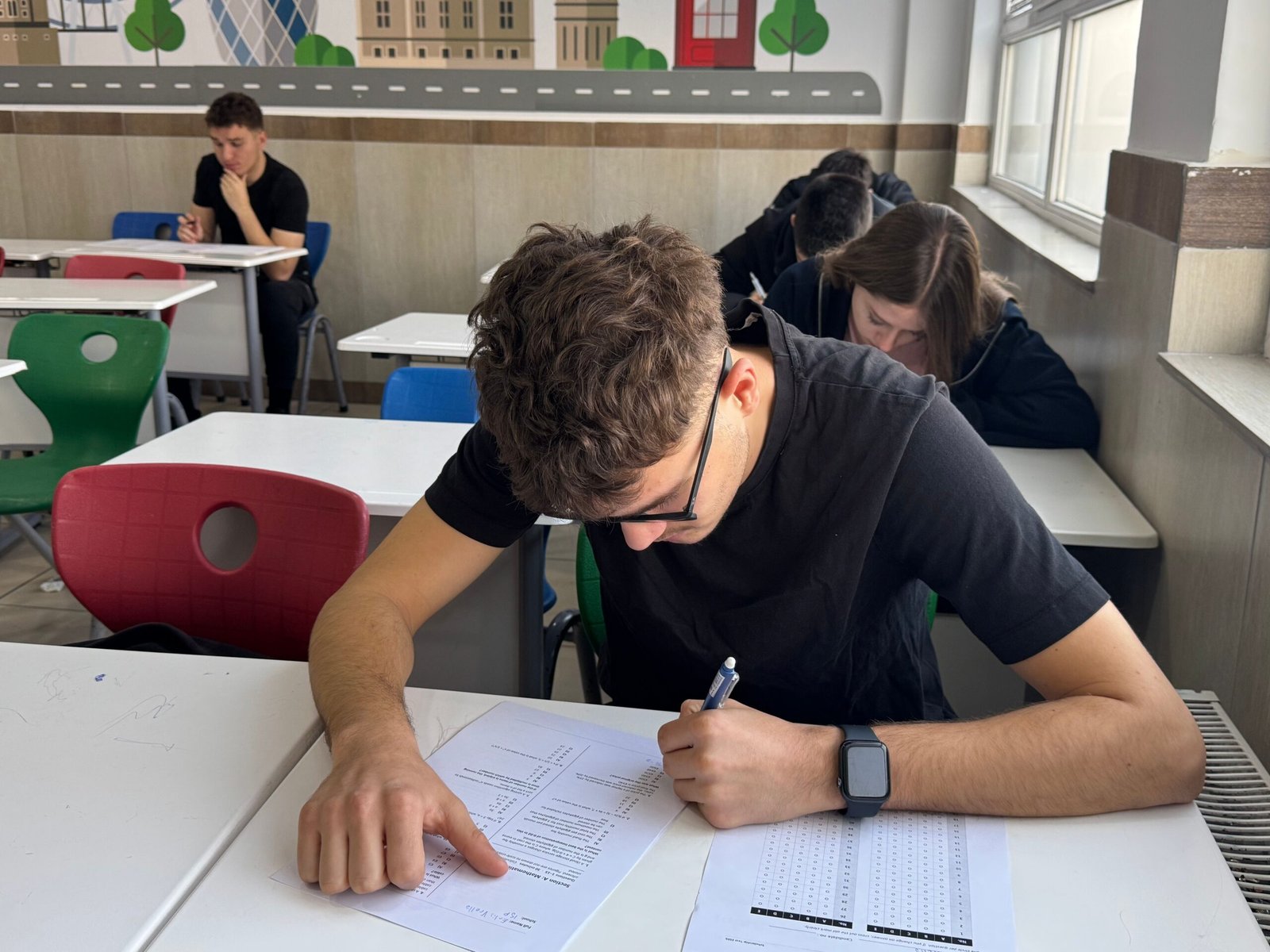
Step 2 — Solve one paper per subject under exam conditions. Sit for the full 3 hours 15 minutes in one sitting, phone away, with only the material the exam allows. For Class 10, practise filling the OMR sheet inside this attempt itself — it is a separate skill, and students lose easy marks to a wrongly filled circle. Do not look at answers or notes halfway through. The point of this step is not the score; it is learning how it feels to write for three hours and to manage time across sections.
Step 3 — Mark yourself honestly and find the weak chapters. After finishing, check your answers against your textbook and notes. Write down every topic where you lost marks — not just the marks themselves. Most students find that 60 to 70 percent of their lost marks come from just three or four weak chapters. Those chapters are your revision list for the next week.
Step 4 — Revise the weak chapters first, then repeat. Revise those chapters properly, then attempt the next paper — or the same paper again after a gap of seven to ten days. Two papers solved properly are worth more than ten papers only read. Keep a small notebook where you record, for each paper: the date you solved it, your score out of the total, and the chapters where you lost marks. Over a month, that notebook shows you exactly where you are improving.
A realistic target: solve at least one paper per subject in December, and one more per subject in January. Finish your heavy written practice before the practical exam window begins on 27 January 2027, because practicals and pre-boards will take your time after that. Use the last two weeks before 5 February mainly for revision and for one final timed paper in your weakest subject.
Common Mistakes Students Make With Previous Year Papers
- Solving only the easy subjects. Students practise the subjects they like and avoid the ones they fear. The papers you avoid are the ones you need most. Start with your weakest subject, not your strongest.
- Reading solutions instead of writing answers. Writing speed, handwriting and presentation are only built by writing. Reading a solved paper feels like learning, but it does not prepare your hand for three hours of writing.
- Practising from the wrong year. Papers from before a syllabus change can include deleted chapters and an old pattern. Always check the year and match the paper to the 2026-27 syllabus first. Our UP Board Syllabus 2026-27 guide shows you how to check.
- Ignoring the OMR practice in Class 10. The 20-mark objective section is the easiest scoring part of the paper, and also the easiest place to lose marks by carelessness. Practise it in every timed attempt.
- Treating a paper as a prediction. A previous year paper shows the pattern and the level of questions, not the exact questions. Chapters that did not appear last year can still be asked this year. Cover the full syllabus; use the papers to learn the pattern, not to skip chapters.
- Paying for “leaked” or “guaranteed” papers. No one can sell you the real 2027 paper before the exam. Anyone who claims to is running a scam. The board’s own model papers are free, and past papers are available through your school. Never pay, and never share personal details with such sellers.
How Previous Year Papers Fit With the Model Papers and the Time Table
Think of the three together as one preparation kit. The UP Board Model Paper 2026-27 shows you the current pattern and marking scheme for every subject. The previous year papers show you how that pattern has actually been used in real exams, and which topics the board returns to again and again. The UP Board Exam 2027 Time Table tells you the exact date and shift of each paper, so you can plan which subject to practise in which week — practise the subject whose exam comes first, first.
A practical way to plan: look at your date sheet, list your subjects in exam order, and work backwards. Give each subject one timed paper in December and one in January, with revision of the weak chapters in between. If two of your papers fall on consecutive days, practise them back to back at least once, so you know what two long writing days in a row feel like.
FAQs
Q. Where can I download UP Board previous year question papers for Class 10 and 12?
The board’s official website, upmsp.edu.in, publishes the current session’s model papers for free — go to the homepage and open the “Model Paper” link. For the actual previous year papers (the real papers from the 2026, 2025 and 2024 exams), there is no single official download archive. The reliable ways to get them are your school and subject teachers, senior students, the school library’s solved-paper books, and reputed education portals. Never pay for a paper or share personal details to download one.
Q. Are UP Board previous year question papers free?
Yes. The official model papers on upmsp.edu.in are free, and past papers from your school or seniors cost nothing. If any website asks you to pay for a UP Board paper, do not pay — the same paper is available free from the sources above.
Q. How many years of previous year papers should I solve?
The last three years — the 2026, 2025 and 2024 board exams — plus the official 2026-27 model paper for each subject. That is enough to see the pattern and the repeated topics. Papers older than three years can reflect an old syllabus and may mislead you.
Q. Are model papers and previous year papers the same thing?
No. A model paper is a sample paper issued by UPMSP before the exam to show the pattern of the coming exam. A previous year paper is the actual paper students sat in a past exam. Both are useful: the model paper shows the current pattern, and the previous year paper shows the real thing. Use both.
Q. When are the UP Board exams 2027?
Theory exams for Class 10 and 12 will be held from 5 February to 24 February 2027, in two shifts — 8:30 AM to 11:45 AM and 2:00 PM to 5:15 PM. Practical exams are scheduled from 27 January to 10 February 2027. Check the subject-wise dates in our UP Board Exam 2027 Time Table guide and always confirm final dates on upmsp.edu.in.
Q. Is it enough to solve only previous year papers, without reading the textbook?
No. Previous year papers show you the pattern and the important topics, but they do not teach the chapters. If you only solve papers, you will keep failing the same chapters. Read the textbook first, solve the paper to find your weak areas, then go back and revise those chapters. The paper is a test of your preparation, not a replacement for it.
Final Thoughts
Previous year papers are the closest thing to a rehearsal for the board exam — but only if they are the right papers, from the right years, solved under real exam conditions. Start with the free official model papers on upmsp.edu.in, add the last three years’ papers from your school, and solve one paper per subject in December and one more in January. Keep a notebook of where you lose marks, fix those chapters first, and do not pay anyone for what the board and your school give you for free.
The exam dates are fixed — 5 to 24 February 2027. The time between now and then is enough for any student who uses it in the right way. Start this week, with one subject and one paper.
Note: Fizoic is an independent education information website and is not the official website of UPMSP or the UP Board. Always verify final dates and notices on upmsp.edu.in or through your school.
Sources
- UPMSP official website — upmsp.edu.in (homepage, verified live 23 November 2026; includes the 2027 exam time table notice dated 12 October 2026 and the “Model Paper” section for Class 10 and 12 model papers, session 2026-27)
- UPMSP Board Syllabus page — upmsp.edu.in/Board_Syllabus.aspx (verified live 23 November 2026; subject-wise syllabus PDFs for Classes 9 to 12, including subject codes)
- Fizoic — UP Board Model Paper 2026-27 (model papers released for around 34 Class 10 and 44 Class 12 subjects; Class 10 pattern: Part A MCQ 20 marks on OMR, Part B descriptive 50 marks, 3 hours 15 minutes)
- Fizoic — UP Board Exam 2027 Time Table (theory exams 5–24 February 2027, two shifts; practical exams 27 January–10 February 2027)
- Fizoic — UP Board Syllabus 2026-27 (Class 10: 70 theory + 30 internal; Class 12: 70 + 30 for practical subjects, 100 theory otherwise; subject codes)


Leave a Reply