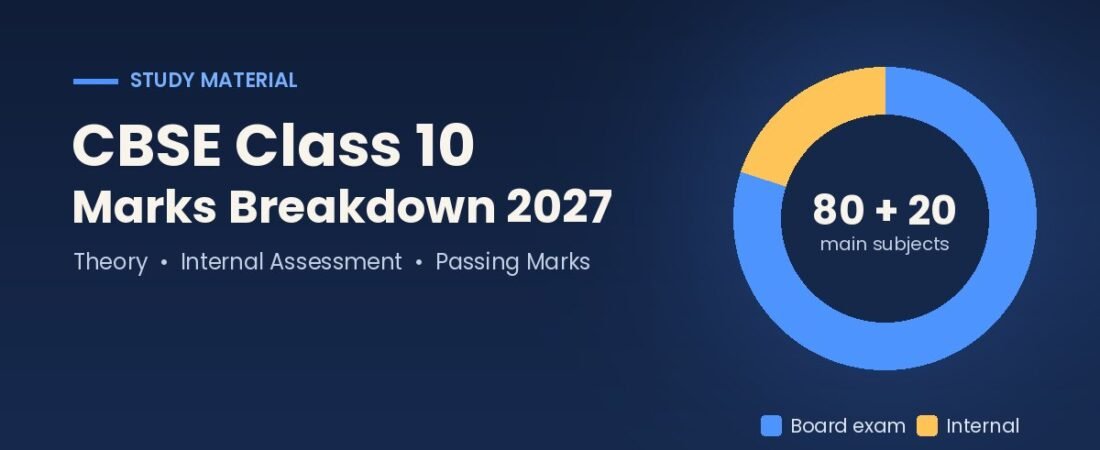
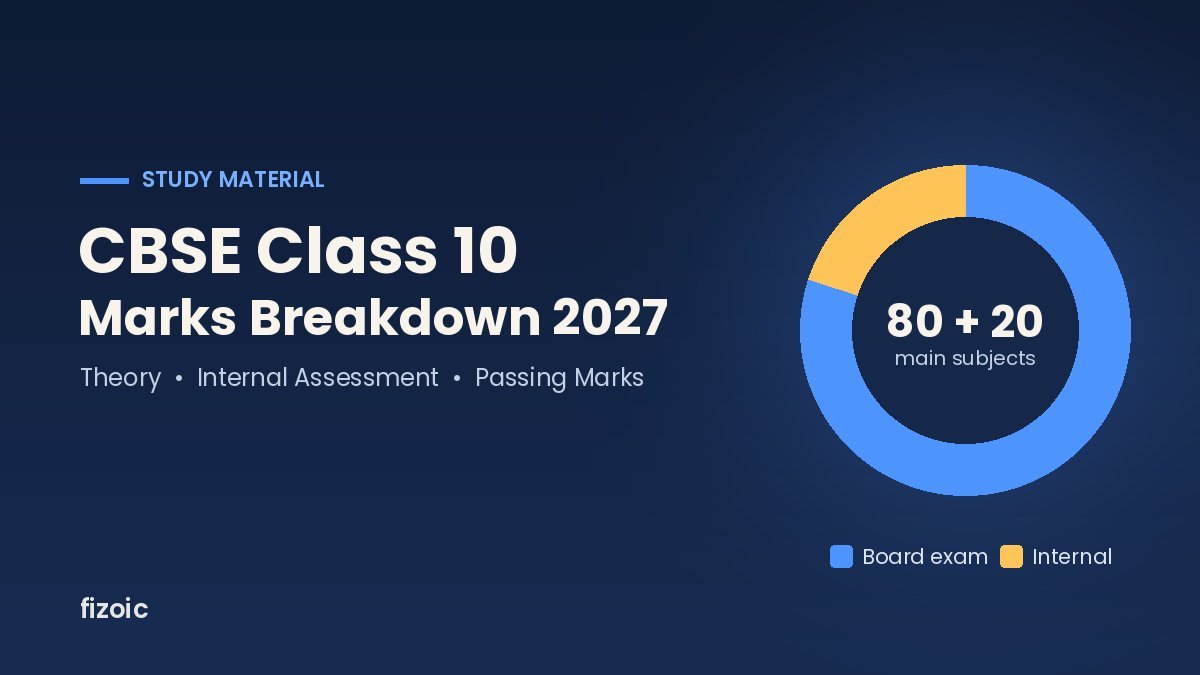
If you’re in CBSE Class 10 this year, your board exams start on February 16, 2027. Knowing where your marks come from will help you plan your revision. Most main subjects have 80 marks for the theory board exam and 20 marks for internal assessment. A few optional subjects use a very different split.
This article explains the distribution of marks for the 2026-27 session, subject by subject. All figures are taken from the official CBSE curriculum for 2026-27 and official CBSE notices, including CBSE’s circular on subject-wise marks bifurcation for 2026-27. If anything is unclear in the official documents, we’ll note it.
Fizoic is an independent student site and is not affiliated with CBSE. Please always check the latest notice on cbse.gov.in and cbseacademic.nic.in.
Who this guide is for
This guide is for students in Class 10 in the 2026-27 session who will take the CBSE board exams in 2027.
That matters because CBSE has announced many changes from 2026-27, such as a third language (R3), Mathematics Advanced and Science Advanced. However, most of them do not apply to your batch yet:
- No change for Class 10 in 2026-27: CBSE’s press release of June 29, 2026 says there will be no change for students in Class 10 during 2026-27. They continue with the old system of two languages, and no third language is required for this batch.
- Maths Advanced and Science Advanced are not part of the 2027 board exams. The curriculum says Mathematics Advanced and Science Advanced (25 marks, 1 hour) start at the Class 10 board level only from 2027-28.
- Mathematics Basic is still available: the curriculum says Class 10 students of 2026-27 continue under the existing scheme and may opt for Mathematics Basic. The 2027 date sheet includes both Mathematics Standard (041) and Mathematics Basic (241).
The basic rule: 80 marks board exam, 20 marks internal assessment
The CBSE curriculum describes two parts of assessment for Class 10:
- The board (external) exam conducted by CBSE. This is 80 marks for most subjects, or the marks given in that subject’s syllabus.
- Internal assessment conducted by your school. This is 20 marks for major subjects, or the marks given in that subject’s syllabus.
Both parts are added together to form your final result. The curriculum also says you must appear in and complete both parts. A student who skips internal assessment cannot be declared successful just by writing the board paper.
For the main subjects, the board paper is 3 hours long.
Subject breakdown (2026-27 session, 2027 board exams)
The table below is taken from Table 5 of the CBSE Secondary Curriculum 2026-27 and the syllabus files for each subject. “Board” refers to the written board exam. “Internal” refers to internal assessment, practical or project marks given through your school.
| Subject (code) | Board marks | Time | Internal marks | Total |
|---|---|---|---|---|
| English Language and Literature (184) | 80 | 3 hours | 20 | 100 |
| English Communicative (101) | 80 | 3 hours | 20 | 100 |
| Hindi Course A (002) | 80 | 3 hours | 20 | 100 |
| Hindi Course B (085) | 80 | 3 hours | 20 | 100 |
| Sanskrit (122) | 80 | 3 hours | 20 | 100 |
| Other languages (Urdu, Punjabi, Bengali, French, etc.) | 80 | 3 hours | 20 | 100 |
| Mathematics Standard (041) | 80 | 3 hours | 20 | 100 |
| Mathematics Basic (241) | 80 | 3 hours | 20 | 100 |
| Science (086) | 80 | 3 hours | 20 | 100 |
| Social Science (087) | 80 | 3 hours | 20 | 100 |
| Home Science (064) | 70 | 3 hours | 30 | 100 |
| Painting (049) | 30 | 2 hours | 70 | 100 |
| NCC (076) | 70 | 3 hours | 30 | 100 |
| Computer Applications (165) | 50 | 2 hours | 50 | 100 |
| Elements of Business (154) or Elements of Book Keeping and Accountancy (254) | 70 | 3 hours | 30 | 100 |
| Skill subjects such as Information Technology (402) and Artificial Intelligence (417) | 50 | 2 hours | 50 | 100 |
Note: Only one of Computer Applications (165) or Information Technology (402) can be taken.
For the language subjects, Table 5 lists Hindi, English and other languages in general terms. The 80-mark papers for Hindi Course A, Hindi Course B and English Communicative come from their own 2026-27 syllabus files. The Hindi syllabus files state 80 + 20 directly. The English Communicative file shows the 80-mark paper and a 5-mark listening and speaking part, and its 20 internal marks follow the curriculum’s general rule of 20 marks for major subjects.
What CBSE’s marks bifurcation circular adds
CBSE has also posted a circular on subject-wise marks bifurcation for Classes 10 and 12 for the 2026-27 exams on cbse.gov.in (the file is dated November 6, 2026). Its Class 10 table matches the splits above, and it shows how the non-board marks are divided in some subjects:
- Painting: 30 theory + 50 practical + 20 internal assessment
- Home Science: 70 theory + 30 practical
- Elements of Business and Elements of Book Keeping and Accountancy: 70 theory + 30 project
- Computer Applications, Information Technology and Artificial Intelligence: 50 theory + 50 practical
- NCC: 70 theory + 30 internal assessment
- Most languages, Mathematics, Science and Social Science: 80 theory + 20 internal assessment
How the internal 20 marks are split
The 20 internal marks are not one single test. Each subject divides them into smaller parts. Here is what the official 2026-27 syllabus files say.
Mathematics (Standard and Basic)
- Pen-paper test and multiple assessment: 10 marks (5 + 5)
- Portfolio: 5 marks
- Lab practical (activities from the prescribed books): 5 marks
Science
- Periodic assessment: 5 marks
- Multiple assessment: 5 marks
- Portfolio: 5 marks
- Subject enrichment (practical work): 5 marks
Social Science
- Periodic assessment (pen-paper test): 5 marks
- Multiple assessment (interdisciplinary project): 5 marks
- Subject enrichment activity (project on Consumer Rights, Social Issues or Sustainable Development): 5 marks
- Portfolio (classwork, activities, assignments, reflections): 5 marks
English
The English syllabus refers schools to CBSE circular Acad-11/2019 for the full 20 marks of internal assessment. It clearly states that Assessment of Listening and Speaking Skills (ALS) is worth 5 marks and is part of the subject enrichment activity.
Hindi and other languages
The syllabus and Table 5 confirm the 80 + 20 split for Hindi Course A and Course B. We couldn’t find a component-by-component split of the 20 internal marks for Hindi in the files we checked, so please ask your school how it will award these marks.
What’s in the 80-mark board papers?
Knowing the unit weightage will help you decide what to revise more.
Mathematics (80 marks)
- Number Systems: 6 marks
- Algebra: 20 marks
- Coordinate Geometry: 6 marks
- Geometry: 15 marks
- Trigonometry: 12 marks
- Mensuration: 10 marks
- Statistics and Probability: 11 marks
Algebra alone makes up one-quarter of the paper. Geometry and Trigonometry together add another 27 marks.
Science (80 marks)
- Chemical Substances – Nature and Behaviour: 25 marks
- World of Living: 25 marks
- Natural Phenomena: 12 marks
- Effects of Current: 13 marks
- Natural Resources: 5 marks
The chemistry and biology units together make up 50 of the 80 marks.
Social Science (80 marks)
- History: 20 marks (18 + 2 map)
- Geography: 20 marks (17 + 3 map)
- Political Science: 20 marks
- Economics: 20 marks
The question design also lists 20 one-mark MCQs and 5 marks for map pointing. Some topics are assessed only internally. For example, the chapter “The Age of Industrialisation” is assessed only in periodic assessment, and parts of “The Making of a Global World” are covered through the interdisciplinary project. Check your syllabus file so you don’t study a topic for the wrong part of the exam.
English (80 marks)
English Language and Literature:
- Reading: 20 marks
- Writing Skills and Grammar: 20 marks
- Literature: 40 marks
English Communicative:
- Reading: 22 marks
- Writing: 22 marks
- Grammar: 10 marks
- Literature: 26 marks
Pass marks: what the official rule says
The CBSE Secondary Curriculum 2026-27 states:
“To be declared successful in a subject, a student must secure a minimum of 33% marks separately in external and internal assessments, calculated on the combined total of Internal Assessment and External Examination marks, as per the prescribed scheme.”
So 33% is the official minimum. The word “separately” points to the external and internal parts, but the same sentence also mentions the combined total, and the document does not give a worked example. We could not confirm from the official text exactly how the two parts are combined for the pass decision.
To be safe, aim for well above 33% in both the board exam and the internal assessment. For reference, 33% of:
- 80 marks = 26.4
- 20 marks = 6.6
- 100 marks = 33
These are just calculations, not official cut-off scores. CBSE’s own pass rules are in its Examination Bye-Laws and result notices.
A second rule may help some students. If you fail in Science, Mathematics or Social Science but pass an optional additional subject you have taken, the curriculum says that subject can replace the failed one, provided you have cleared the required languages.
Grading in Class 10
The CBSE curriculum says Class 10 board grades follow a 9-point scale based on rank among the students who passed in each subject. A-1 goes to the top one-eighth of passed candidates, A-2 to the next one-eighth, and so on down to D-2. E means Essential Repeat. This method is used when more than 500 candidates pass a subject.
The second board exam: what we know
CBSE introduced two board exams for Class 10 through a notification dated June 25, 2025. The main rules are:
- The first exam is the main exam, and it is compulsory for all students.
- Passed and eligible students can try to improve their performance in up to three subjects from Science, Mathematics, Social Science and languages.
- If you do not appear in three or more subjects in the first exam, you cannot take the second exam. You will be placed in the Essential Repeat category.
- Students with a Compartment result in the first exam can take the second exam in the Compartment category.
- Internal assessment is conducted only once, before the main exam.
- Both exams cover the full syllabus for the year.
- The notice says the main exam is held in mid-February and the second exam in May.
A clarification dated February 14, 2026 repeated these rules. In 2026, CBSE held the Class 10 second board exams from May 15 to May 21, 2026, as per its official date sheet.
As of November 17, 2026, we could not find a separate CBSE notice or date sheet for a 2027 second exam on cbse.gov.in. Do not trust any “second exam 2027 date sheet” until it appears on the official website.
Important 2027 Class 10 dates
From the official CBSE date sheet dated November 6, 2026:
- Painting: Tuesday, February 16, 2027
- Mathematics Standard and Basic: Wednesday, February 17, 2027
- Science: Monday, February 22, 2027
- Computer Applications, Information Technology and Artificial Intelligence: Wednesday, February 24, 2027
- English Communicative and English Language and Literature: Friday, February 26, 2027
- Sanskrit: Monday, March 1, 2027
- Hindi Course A and Course B: Wednesday, March 3, 2027
- Social Science: Monday, March 8, 2027
- Last Class 10 papers (including NCC and Elements of Book Keeping and Accountancy): Tuesday, March 9, 2027
All exams start at 10:30 a.m. Main subject papers run from 10:30 a.m. to 1:30 p.m. Painting, Computer Applications and many skill papers end at 12:30 p.m. Check your own subject codes on the full date sheet. If you’re in Class 12, see our CBSE Class 12 Date Sheet 2027 guide.
Revision tips based on the marks split
- Treat internal assessment as real marks. You get 20 marks out of 100 in every main subject. CBSE’s two-exam notice says internal assessment is conducted only once, before the main exam, so do it well.
- Keep your portfolio organized from the start. Maths, Science and Social Science each give 5 marks for the portfolio. Save classwork, assignments and reflections as you go.
- Don’t skip practical and lab work. Science gives 5 marks for practical work, and Maths gives 5 marks for lab activities.
- Plan your Social Science project early. The project and interdisciplinary work carry 10 internal marks between them.
- Practice speaking for English. Listening and speaking skills carry 5 internal marks.
- Revise by weightage. In Maths, start strong with Algebra (20 marks). In Science, give steady time to the chemistry and biology units (25 marks each).
- Learn your maps. Map work carries 5 marks in the Social Science board paper.
- Use official sample papers. CBSE has released 2026-27 sample question papers and marking schemes for Class 10 on cbseacademic.nic.in. Solve them under a 3-hour timer.
- Use the gaps in the date sheet. For many students, the next main paper after Science on February 22 is English on February 26. Plan your revision for each gap.
FAQ
Is the CBSE Class 10 board paper 80 marks in every subject?
No. Most main subjects have 80 board marks plus 20 internal marks. Some optional subjects are different. For example, Painting is 30 + 70, Home Science is 70 + 30 and Computer Applications is 50 + 50.
Do I need to take a third language in the 2027 board exams?
No new third language is needed. CBSE’s June 29, 2026 press release says students in Class 10 during 2026-27 continue with the old system of two languages, and no third language is required for this batch. However, under that older scheme, the curriculum still says students must have passed the third language they studied up to Class 8 in their school’s internal assessment. If you’re unsure about your own case, please check with your school.
Is Mathematics Basic still an option in 2027?
Yes. The curriculum says 2026-27 Class 10 students may opt for Mathematics Basic, and the 2027 date sheet lists Mathematics Basic (241) on February 17, 2027.
Can I skip the February exam and only take the second exam?
No. CBSE’s notices say the first exam is compulsory. If you miss three or more subjects in it, you cannot take the second exam.
Are there any Advanced papers in 2027?
No. Mathematics Advanced and Science Advanced begin at the Class 10 board level from 2027-28, as per the curriculum.
Related guides on Fizoic
- CBSE Class 12 Date Sheet 2027: how to download the official PDF
- UP Board syllabus 2026-27 (for UP Board students comparing boards)
Official sources
- CBSE Secondary Curriculum 2026-27 (main document)
- CBSE curriculum page 2026-27
- Circular on subject-wise marks bifurcation, Class X/XII, 2026-27
- Mathematics syllabus Class 10 (2026-27)
- Science syllabus Class 10 (2026-27)
- Social Science syllabus Class 10 (2026-27)
- English Language and Literature syllabus
- English Communicative syllabus
- Computer Applications syllabus
- Home Science syllabus
- Class 10 sample papers and marking schemes 2026-27
- Date Sheet for Class X and XII Board Examinations 2027 (November 6, 2026)
- Two Board Examinations in Class X notification (June 25, 2025)
- Two Board Examinations clarification (February 14, 2026)
- Second Board Examination date sheet, Class X 2026
- Press release on three-language guidelines (June 29, 2026)
- CBSE official website

Leave a Reply